differences between trams, light rail, and busses.
2022 07 16
content warnings
we wrote this to be comprehensive to others. the words aren't for us. the interest in making them good for others has exhausted us from making them good for ourselves. this is mostly written for others.
the words are not ours, and we don't have the spoons to make them ours. ugh
intro
recently, we were looking at an openstreetmap relation that showed part of the [fr] réseau express métropolitain, a train line under construction on île de montréal, along autoroute 40.
curious, we wanted to check the other relations to see the whole thing, so the part towards deux montagnes and centre ville and the south shore.
they didnt exist! at least not the centre ville section (we only checked it). however, we noticed that they used different railway types: the section along autoroute 40 as "tram" and the centre ville section as "light rail."
aaaaaaaaaa
to get you on board with some context to this, here is a tram, and this is a light rail train.
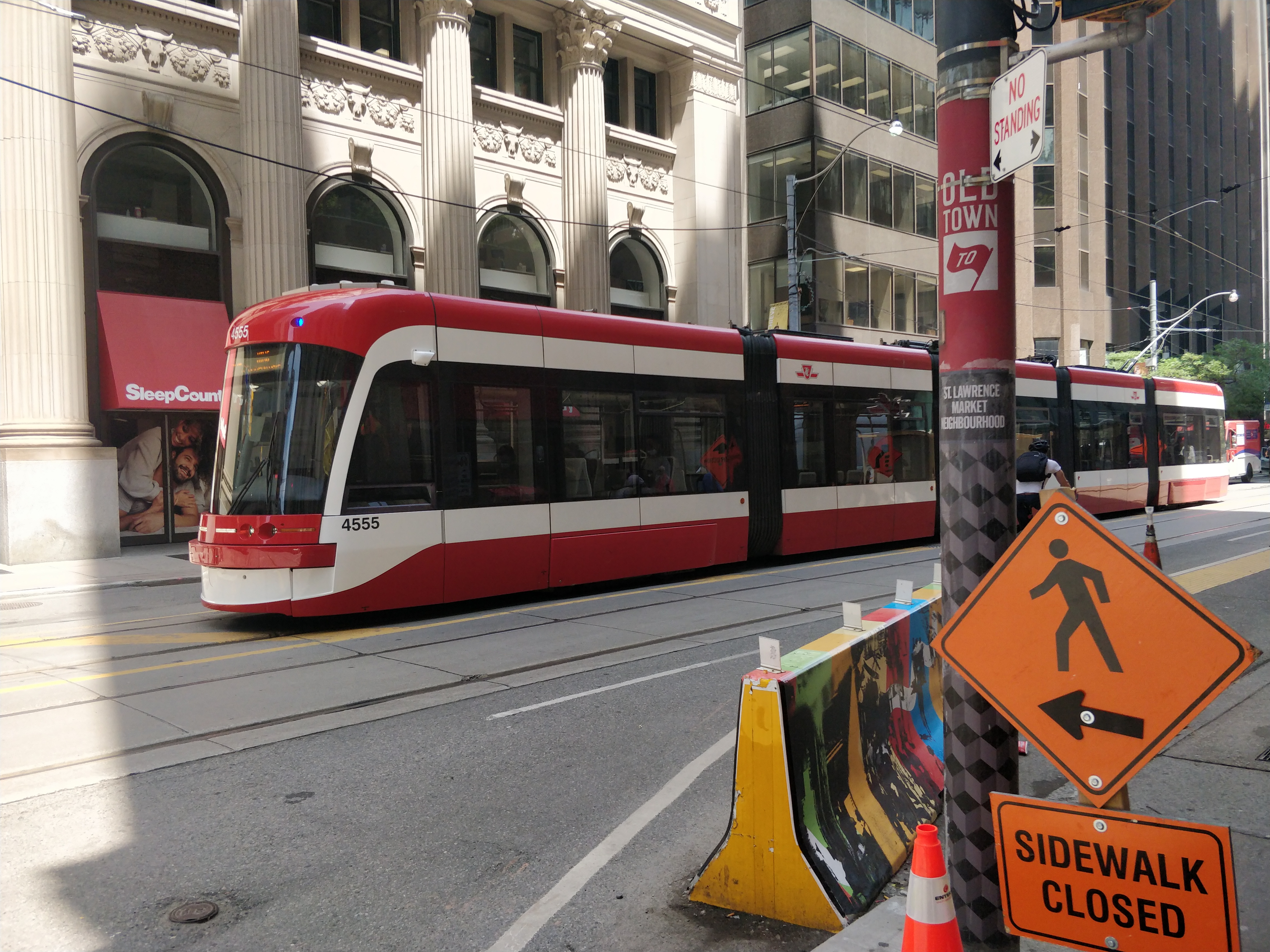

visually, these vehicles look very similar. they actually are technically very similar, too!
they both have low, platform height floors, are both electric and connect to overhead power lines, are somewhat small for a train, and are light, physically.
the light rail train does operate faster than the tram shown, but in other parts of the world it would still be called some type of tram.
people are often confused by this when a new light rail line is proposed or built. They are similar, but others sometimes insist they are different! It just all seems so confusing, it's so hard to find distinctions.
also, light rail is used to describe a lot of very different things!!! so once someone does find a distinguishing characteristic, they will almost always eventually find a case where that isn't true.
what is light rail!!!
where we live, organisations will make distinctions between trams and light rail.
usually, these distinctions fall under things like higher priority, more railway-like operation compared to bus-like operation, dedicated corridors, and higher top speed. In the specific page we linked, they also say LRT (light rail transit) can go underground like subway (métro souterraine), and are bidirectional (as opposed to unidirectional), which is very funny to us.
however,, there are many light rail systems where!! where they operate identically as trams do.
The train line in the image example we used for light rail, was originally going to operate on-street in centre ville, because the density was so high that there wasn't enough space for a dedicated right of way, separate from other traffic. not only is this very funny, given that the train line was constructed to relieve congestion on the surface streets caused by a BRT line, but it ALSO would mean it operated like a tram, and not like a light rail line, in centre ville.

stuff like this happens all the time where we live, and is sometimes advertised as a feature of light rail. It can run on the street if it needs to to save costs or something, and blah blah blah boring PR shit about flexibility.
in usage, this advertised feature has made the term "light rail" rhetoric for "shiny passenger train". much like populist political campaigns, it implies something far more specific than is actually the case, and this vagueness allows people (especially political marketing departments) to take advantage of the term to mean what is most convenient at the time, usually resulting in a pretty shitty rail line for actual transportation.
we think viewing "light rail" as a large, inclusive mega category of transit is more useful and healthy than applying a strict qualitative defintion of light rail.
under this perspective, we aren't encouraged to separate trams from light rail, which makes a lot more sense! because trams are literally a type of light rail (especially in the past, trams were stigmatised where we live, so it was politically convenient to call them something else, and it rapidly got out of hand)
we think we define tramways and light railways as, low to medium capacity passenger railways that almost universally operate local-to-local services. They are notably physically smaller than métros, and always have less prioritisation than a métro. Generally, they also have less intensive infrastructure than a métro, because of less intensive operating requirements.
by far the most important aspect about this distinction is capacity, with the second most important being operating intensity.
back to the rem.
the réseau express métropolitain, short form is "rem", is neither a tram nor light rail (this doesn't neccesarily mean the tagging in osm is incorrect!).
the organisation, describes it like this: Le Réseau express métropolitain (REM) est un nouveau mode de transport de type métro léger.
what they are saying here is that rem is a light métro. light métro means something specific.
firstly, it's important to understand that a métro is a electric high to very high capacity passenger train that is given extremely high priority, and this is pretty much a universal characteristic between all métros. the "light" part indicates, usually, that the trains are physically smaller than normal métro trains, usually by being less long, and filling the medium to high capacity range.
largely, light métro trains have a similar design and infrastructure design style as regular métros, and so they basically just operate as a lower capacity version of them, without much differences. They often use the same trains, just shorter, and they still have very high prioritisation.
we think that the rem is a very good example of how light rail is misleading and is more of a categorical framework than a specific type of railway.
in english, people still often call rem light rail, and in the case of osm, they even can call it tram! this is despite, being very different from the kind of transit that we used to demonstrate what a tram is.
we think prioritisation is very different between light rail and a light metro! as much as we'd like to be inclusive and say that light metro falls into that category, because being exclusionary sucks,
the german word for light rail is "stadtbahn," which literally means "city railway" or "city train". this name, at least when interpreted literally, is significantly more vague, and we think that is useful! it is just a train that runs in a city, for usually local trips.
in addition, we've also noticed that this is actually how light rail is used in english, even if most people dont realise it, just by nature of how many vastly different things are called "light rail" (ottawa calls its line 1 light rail while it is trying its best to be a métro, and its line 2 is also called light rail, and it is just heavy rail lol)
rem is definitely a city railway!! it is also definitely not a tramway!
what is the difference between light métro and tram?
in comparison to a métro, a tram has some important characteristics that distinguish it from a métro:
- they operate very similarly to city busses
- trams (and light rail vehicles in general) are physically smaller than a métro vehicle
- trams are bendier for city intersections (require less intensive infrastructure)
one of the most important characteristics about a tram, is that it is, usually, low priority, at least relative to métros.
these differences basically all apply to light metros! light metros may be smaller than metro trains, but they are still bigger than trams! they also use métro-like infrastructure.
differences between a tram and a bus
initially, it may seem like bussies and trams are different, intrisically. one uses train tracks!!!! most of these differences are either perceived, or, from politcal decisions, and i need to tell you these are probably due to a (classist) stigmatisation of bussies and a romanticisation of trams in media.
where we live, trams routes almost always have better prioritisation, more frequency, and a more high quality and thoughtful design than bussies. These are not inherent differences, but rather, a lack of interest in making bussies good to use and the alure of the shinyness a tram has.
aside from wholly perceived differences (trams ARE shiny and ARE pretty), most differences we hear people talk about are these, which we call soft differences. These are differences that are not inherent, but that often happen. A less upsetting example is fuel source: bussies can use both grid electricity and battery power, like trams, but due to logistics (and some nasty cultural and political things), the overwhelming majority of bussies use combustion engine; diesel fuel.
trams and busses are very similar in their use cases, design and implementation. they are both low priority (relative), low-medium capacity (relative), they can be bendy, and some other things. They are also surpisingly similar in visual design!
in fact, the only tangible difference to us is the wheels.
wheels
tram wheels are made of metal (so is the track), and metal is very electric conductive. Busses use rubber tyres, which are the opposite of electrically conductive. So, in comparison to bussies, trams need less overhead electrical wires to complete a electric circuit, and are less complex to power by overhead wires. In a similar vein, the rail track ensures that the tram is always in the same position in a given part of the line, meaning that de-wiring is much easier to avoid and plan for.
As a result of this, and because of the numerous inefficency and equity issues for battery bussies, most bussies use combustion engines, the soft difference we shared. this has the knock-on effect that bussies mostly have a shorter lifespan than trams, because combustion powered vehicles universally has lower lifespan than electric powered vehicles.
the wheels combined with rail track, which keep the tram in a specific, predefined position, on its own, is where a lot of the differences between busses and trams come from.
trams don't have steering wheels (they physically cannot be steered like a autobus!), and we think this is one of the reasons why trams are almost always bi-directional, compared to bussies, which we don't think can be at all. the rails also make having a long vehicle possible! trying to safely weave and navigate through a roadway (especially with traffic!), and trying to reverse, with a 30 metre long bussy, is... very, difficult.
from our experiences, trams are usually described as higher capacity than bussies. this was confusing to us for a long time! we didn't understand why you couldn't add more segments onto a bendy bussy, like you can with a tram, until we realised how important rails are for long, bendable vehicles.
busses can live in guideways, which ensure a bussy stays in the same, pre chosen location at all times. this gives busses rails to travel on, letting them have big, long vehicles, and other things that trams have. we do not think this counts as a shared trait!
we view rails as the defining characteristic for trams, and more broadly, trains, and in fact, guided bussies (little cuties) are nearly identical to a rubber tyred tram. they fall under the same "overengineered train" description we use for things like rubber tyred métros and monoraails, which interestingly also use concrete guideways!
end
we think that categorising transit into discrete boxes, like a lot of things, is unnatural and can be detrimental and unhealthy, because most things in this world are fluid and nonbinary, and complex, so fitting them into hard categories is inherently unnatural.
at the same time, a lot of people want to be able to call something a certain thing! even if it may be detrimental overall, people still find easy categories accessible and can help them get to grips with how the world works. in addition, subways do feel different from a tram, which do feel different from busses, even if qualitatively, the tangible lines between them are very thin and obscure.
and in any case! there are some real important differences that generally do actually hold water. specifically, capacity, and prioritisation order.
most of the reasons why different transit feel different are in some way related to their capacity and prioritisation. dedicated right of way trams and busses are higher in the prioritisation order, which makes them feel different from non dedicated right of way trams and busses.
we tried to emphasise these because we think they are the most concrete and useful, and are the least harmful way of categorising transit.