metaphor, subtext, and direct
2023 02 21
a metaphor, at least how we're using it here, is something that represents something else. so like, in the game celeste, the mountain could be interpreted as a metaphor for the journey to self care, love, and advocacy, because climbing a mountain takes a lot of time, resources, determination, and spoons.
subtext is when an idea is implied rather than stated outright, and we think it has similar impacts as metaphor in art. an example of subtext is how in xenoblade 2, the characters mythra and pyra are part of a plural system called pneuma, but this is never acknowledged within the game!
being direct, in contrast to these, is saying these ideas outright. xenogears is very direct with its plural system, going so far as to tell the player the specific medical term!
we think each of these, in art, is super interesting, and they have things we want to talk about.
metaphor
we think metaphor is useful to express a difficult or large idea in an accessible way, and it also lets the art have more different kinds of expression! metaphors can also be really really impactful and effective, and also let people interpret things in a way that is accurate to theirselves.
in celeste, there is a point in the game where the main character, celeste (/joke) looks into a mirror, and tries to run away from what she sees, but eventually the part of her she saw in the mirror, purple celeste, comes through and knocks her off the mountain, making her have to restart again. celeste reconciles with purple celeste, and stops trying to force that part of her away, and they go back at climbing the mountain much faster and more determined than before.
this could be interpreted as a lot of things. we like interpreting it as a metaphor that represents social stigma and feeling the need to mask and be someone others will like, we like interpreting it as a relapse and why that's okay, we like interpreting it as running away from plurality/ourselves and how that just hurts us, and how accepting and embracing who we are is what is best for us. the best part about the metaphor, is that it works for all of these! while working for other ones. it's really inclusive in that way, and it lets lots of kinds of people understand it in a way that is most special to them.
we also think that it being metaphorical lets it be a lot more accessible, in some ways. explaining our interpetations in a impactful way directly would be much more difficult, and would be difficult to understand for someone who doesn't have the same experiences, or the same amount of spoons as ourselves when we wrote it. and probably also involve less creative expression. metaphors may also help de-pathologise mental health and illness, at least in this context, and we think that's cool. it lets things be fluid and have poorly defined edges, and be maluable.
we find metaphors challenging because they aren't direct. if we aren't able to recognise them, it doesn't resonate with us. when we first played celeste, the story wasn't significant for us, we didn't get the subtext and metaphors. we think this is related to spoons. we think that even though metaphors can help us low spoons internalise something big and complex when we have low spoons, metaphors can also be completely inaccessible when we are low spoons, because they involve picking up on abstract things and connecting them.
we think metaphors can be really strong and impactful, maybe because of the processing and interpretation they require. umurangi generation can be interpreted as colonialism, systemic oppression, fetishisation of marginalised groups as a aesthetic, and a bunch of other completely unrelated things. in the game's dlc, and probably the end of the main game too, each level progressively drops the metaphor more and more, and we think it hits really hard. there's been a lot of build up that gives us the idea of what this world is like, and how awful that is, and then we get to see that directly. we think metaphor may also give more room for other kinds of expression, like different surface level art styles, and also are more compact, but we don't know how to articulate this.
we think metaphor might help with understanding complex or hard ideas because it sorta acts as a guide for how to think, and it's like a puzzle you unravel on your own. it isn't overwhelming in the same way saying it directly would be. it also lets people explore things within the metaphor, since its border are fuzzy and non-rigid.
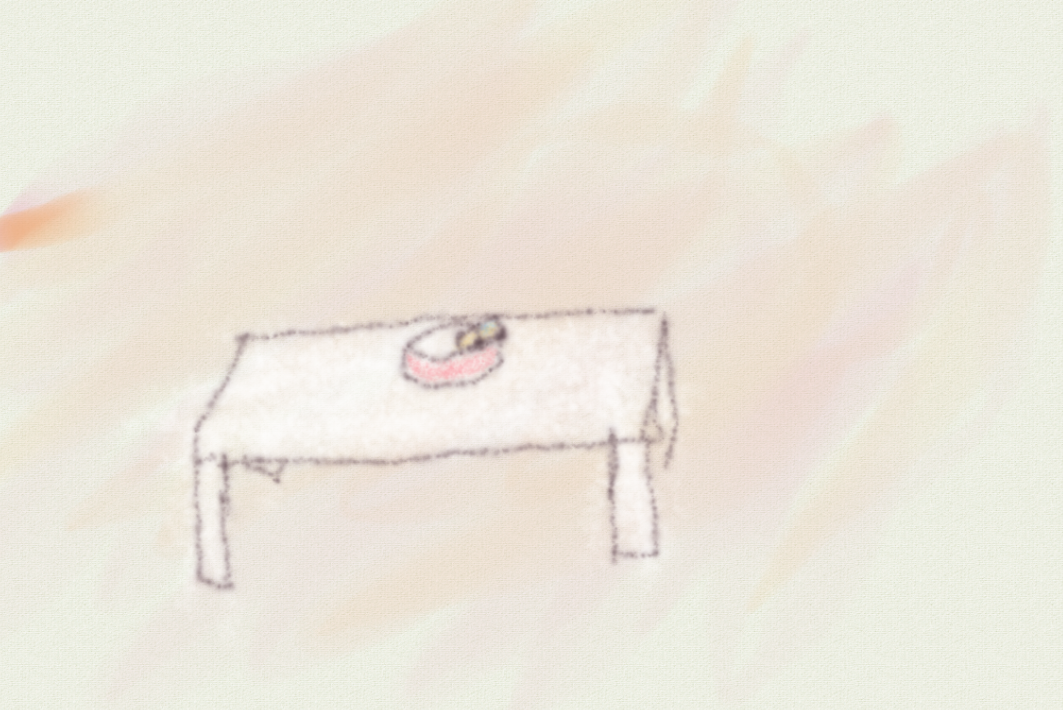
this is a metaphor. there is a layer cake on a table, and a school bus poking out from it. the first tier of the cake represents a problem: we don't want a cake on the table (less room to sit!)! the school bus represents a patchwork solution to the underlying cause. it covers up the problem and makes it feel less bad, but it doesn't really go in and fix it.
using this ass a metaphor let's us explore some other concepts more accessibly. like, what does it mean if you add more tiers, or connect them together, or add something onto the school bus? adding more things on top makes the issue more complex and messy, while only slightly allevating another surface level issue by hidiing it under another layer. it could also be interpreted to mean that the more individual solutions are applied to complex issues, the more difficult it is to resolve the underlying issue, since there is so much on top of it that has to be dismantled first. we didn't intend for that when making this metaphor, and we don't know if we agree or disagree, but it's cool that the metaphor allowed us to think about and ask ourselves in the first place! that's kinda what we mean that it lets us explore ideas.
here's another one! what does it mean for someone to eat the cake? what if this is obssessive compulsive! that could have a lot of depth with just a table a cake and brain self harm.
subtext
subtext is useful we think when we want to say something directly, but want to have some of the flexibility of metaphors, like varied and adaptable interpretations.
for the most part, we don't think subtext is as special as metaphors.
we think metaphors and subtext are usually the default when writing stories, and that may not be healthy! defaults can be harmful.
subtext, also like metaphors, let's the tone and appearance of the surface level stuff be more diverse.
our example from xenoblade 2 for pyra and mythra we think specifically makes the characters also feel more like people, and also like their lives have depth not explicitly shared. same interpetation stuff as metaphors, but without using metaphors!
we think subtext is way less accessible than metaphors. they are something you have to hope is there and you need to have the ability to figure out what that is, and that can be really challenging, way more than metaphors we think.
direct
direct in art is really useful for saying things powerfully and also being accessible. we really like that xenogears is extremely direct in its themes, and we think it makes it special and it does really cool things because of that. it also makes playing xenogears difficult! the bad stuff doesn't get masked behind something else for a bit, which makes it challenging to play healthily. it's exhausting!
we generally prefer direct communication than subtext because it's easier to understand and also it doesn't have to be overwhelming. it can also help give direction and guidance, which is important!
we love accessibility and inclusivity and love and self care ❤❤ we told therapy about celeste metaphors. we want to express our feelings in interesting ways. don't have many spoons to think right now and think we should focus on accessibility and inclusivity and kindness. our editor is pink and we love the heart emojis in our text!